Decades ago, while scripting a documentary on the subject of explorers in Kansas, and specifically taking up the Coronado mystique in local legend, I collected some documentation on material relics of Spanish exploration: blades, spurs, and in particular, fragments of chain mail. A fine poet from Hutchinson, Steve Hind, used to joke that all these Spanish explorers must have just been falling apart as they crossed the central plains, because you find pieces of them everywhere. Local collectors prize such finds and, irrespective of any evidence, attribute them to Coronado in 1541.
This brought me to the intriguing story of Prof. Johann Udden and the chain mail from Paint Creek. I wrote about the mystique of Spanish iron, and Professor Udden in particular, in a Plains Folk column dating from the year 2000.
The Juan Gallego sword, inspiration for the Coronado passages in Willa Cather’s My Antonia, is just one of many pieces of Spanish metal plowed up on the central plains and attributed, by popular demand, to the Coronado expedition of 1541.
In about 1929 a fellow named Bryan White was nosing around a place called Horsethief Cave, near the Cimarron River northeast of Liberal, when he found a Spanish bridle and some buckles. The local newspaper later explained, “What everyone wanted to believe was that the finds were left centuries ago by Francisco Coronado’s expedition.”
It went on to say that the Smithsonian Institution had confirmed the artifacts were from the same period as Coronado, and from that concluded, “The authentication proves without a doubt that a Coronado party did indeed pass through here.” The bit is now on exhibit at the Coronado Museum of Liberal.
Want more evidence? In 1941 George Hayward and his son Jack were out at Point of Rocks, now in the Cimarron National Grassland, and at the base of the rock they found an inscription: “Fran. Vasquez de Coronado.” A fellow from Boise City described as “an old timer” (he must have been REALLY old) confirmed that the script of the legend was authentic and that “we have no other alternative than to believe that the above inscription is the signature of Francisco Vasquez de Coronado.”
I don’t know about you, but I can think of a few alternative explanations. Still, I don’t think that’s the point. I think the point is that in these parts we love our antiquities. We want to have an ancient past. We want our country to have what great civilizations have—relics and ruins.
I turn now to the chronicle of the most famous piece of Spanish iron ever to grace the annals of the central plains—but the story pains me, for at its center is Professor Johann Udden, of Bethany College, my undergraduate alma mater. And the evidence is disturbing.
The professor became well known regionally for his excavations of Indian village sites on Paint Creek in the 1880s. One dig turned up, sure enough, a hand-sized chunk of chain mail, widely assumed to have come with Coronado. (Hey, isn’t that his castle up there on Coronado Heights, the one with the WPA plaque on it?) All the artifacts of Udden’s Paint Creek work were catalogued into the collections of the college museum—except the chain mail. Shortly afterward Udden left the college, and the chain mail disappeared for nearly a century.
Historian and editor Paul Jones of Lyons was kind to Professor Udden, speculating, “It was presumed that a Swedish maid, mistaking it [the chain mail] for a worthless bit of iron dishrag, threw it out with the trash.”
Do I have to spell this out for you? Professors at the college were poorly paid, after all. Eventually a collector in Albuquerque contacted the Kansas State Historical Society, resulting in the repatriation of the Udden chain mail. The seller’s papers showed that it had come to Albuquerque by way of a private collector in western Kansas. Today the Udden chain mail is on exhibit at the state historical society, alongside the Juan Gallego sword and a Spanish bit from Rice County—none of them identified as coming from the Coronado expedition.
There I left the story, working in pre-Google days, not knowing what might have become of Prof. Udden after he left Bethany College. Then, this week, with family in Waco, I walked through the Mayborn Museum at Baylor University, specifically the room full of marine fossils. Where I encountered this exhibit case.
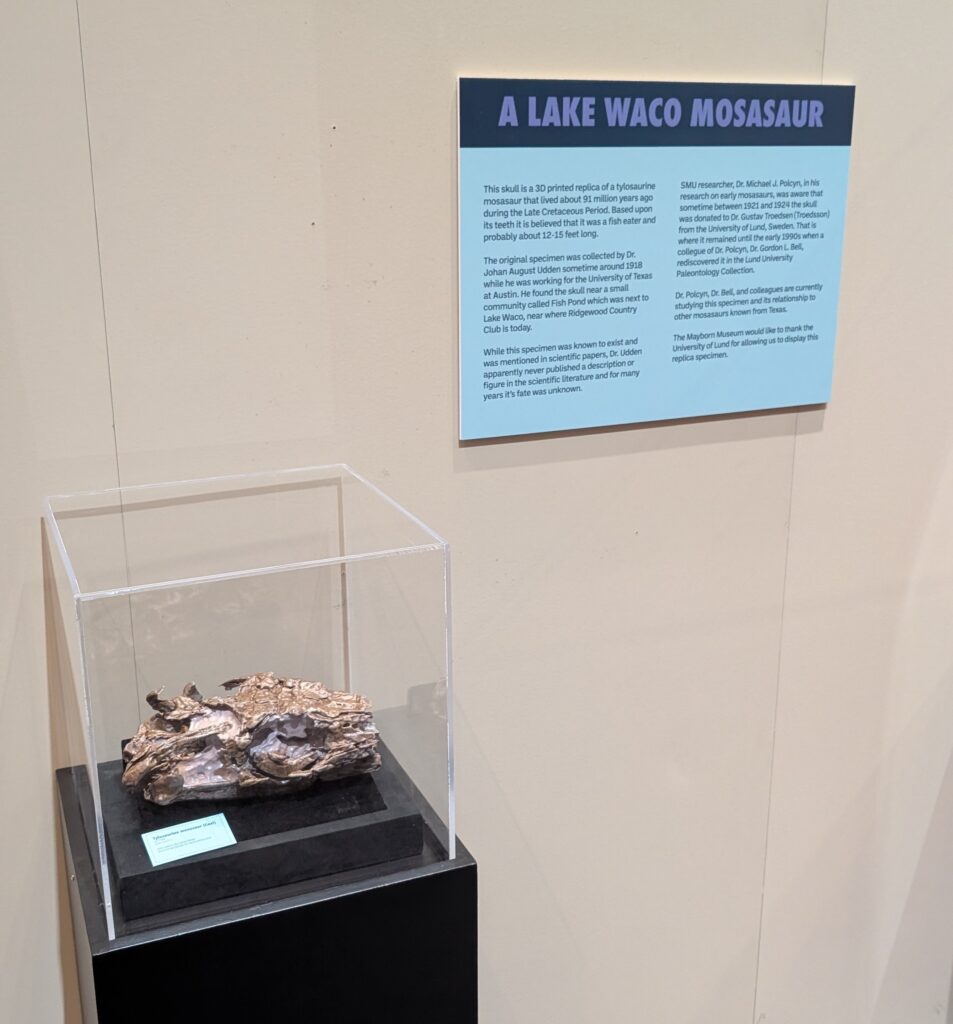
The contents were a cast of the skull of a mosasaur found at Lake Waco in 1918. Now let’s zoom in on the legend.
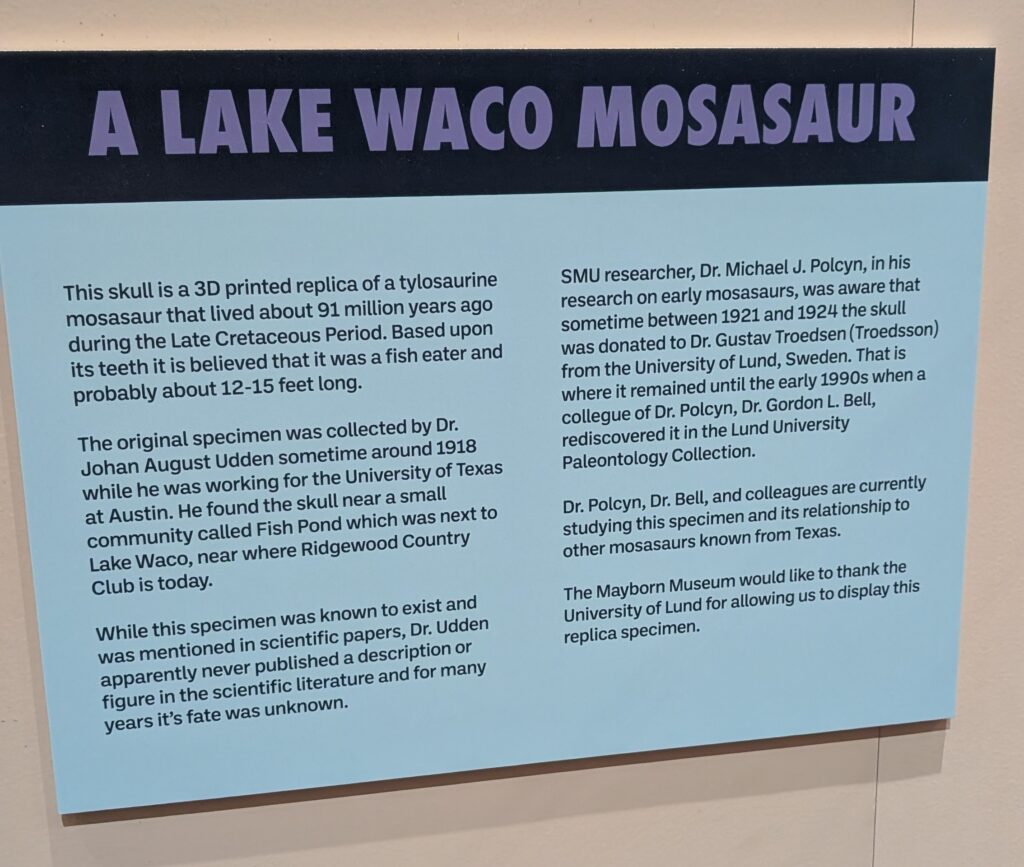
Wherein we read, “The original specimen was collected by Dr. Johan August Udden sometime around 1918 while he was working for the University of Texas at Austin.” I immediately suspected this was my Prof. Udden, who had absconded with the chain mail from Paint Creek.
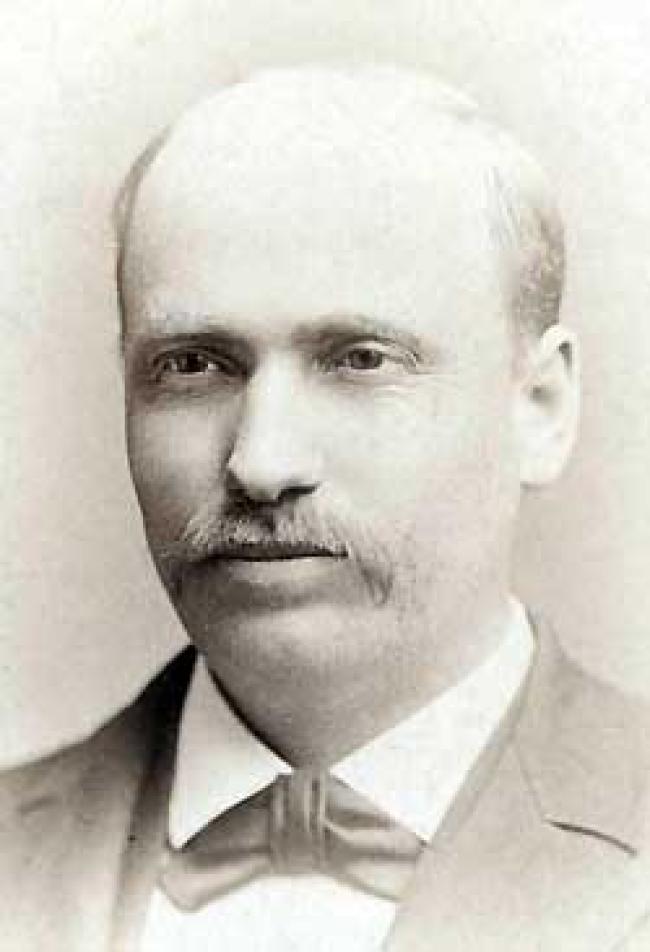
Having made the connection, it was easy to find out what had become of Udden. He had done well for himself, judging, for instance, by this sketch in the Handbook of Texas. He received four honorary documents, including one from Bethany College; held several academic positions and other agency appointments; and eventually answered the call of petroleum, serving the University of Texas as an economic geologist, where reportedly he “was the first to suggest the likelihood of finding oil on university lands in West Texas.” Udden’s alma mater in Illinois, Augustana College, exhibits pride in his connection and also mentions his service 1882-87 at Bethany in Kansas. Nobody mentions Paint Creek or the missing chain mail. After all, King Oscar of Sweden honored him with the Order of the North Star.
Steve Hind, he of the wry remarks about rusty Spaniards falling apart as they crossed Kansas, concludes one of his best poems with the declamation, “O indirection! Keep coming round that bend.” I feel like I have finally come around the bend on the eminent Prof. Udden.
